
01
It’s who you know.
Build a lasting network of peers, mentors and global partners that extends well beyond the ten days.
AFRICA → EUROPE
A transformational 10-day experience taking 30 African women leaders to Europe to build practical capabilities in entrepreneurship, AI and global business growth.

THE EXPERIENCE
WLI Exchange is designed as an intentional journey: learn in the classroom, see innovation in action, build relationships across borders, and return home ready to lead differently.
Discover the programme →Build a lasting network of peers, mentors and global partners that extends well beyond the ten days.
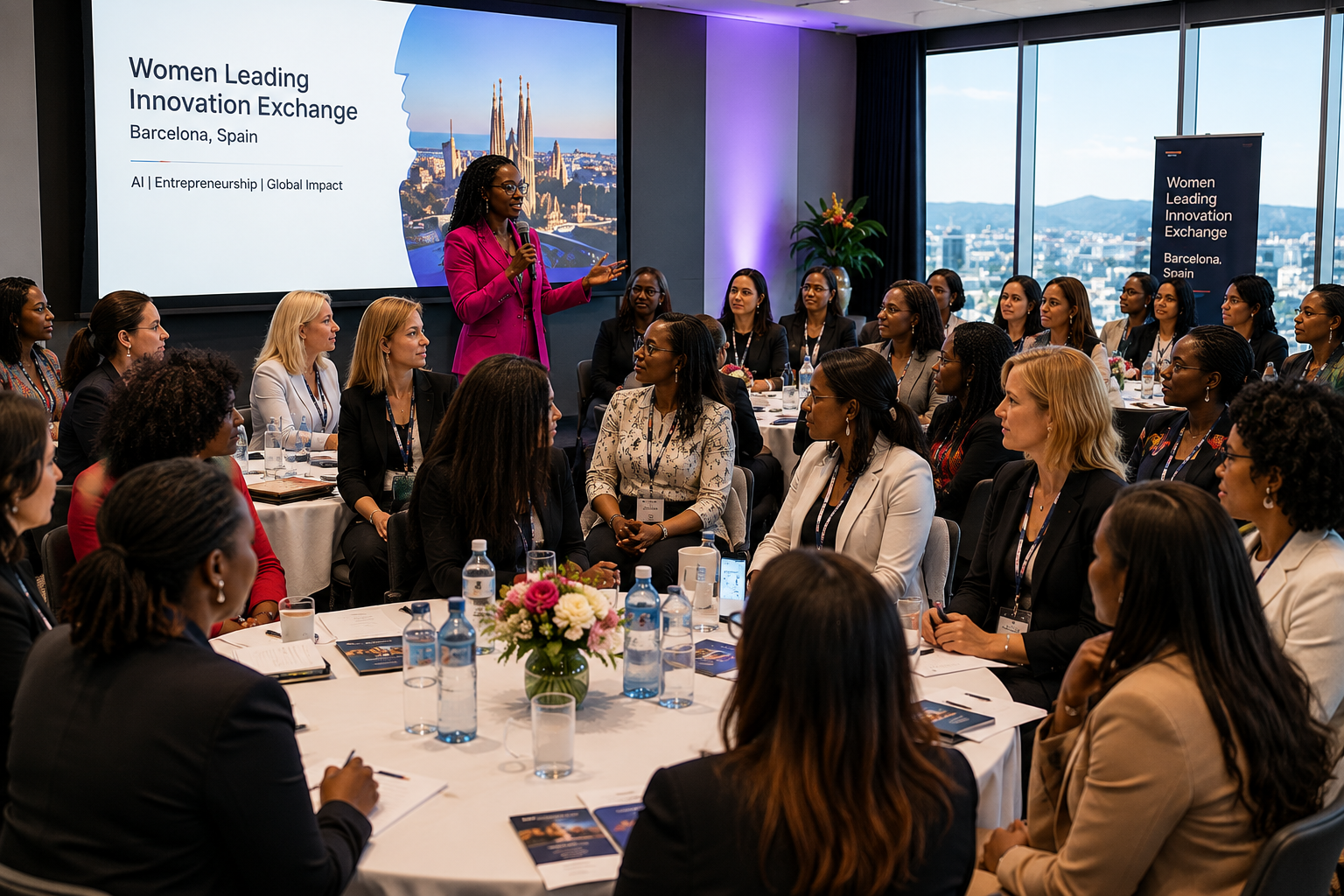
Gain practical exposure to entrepreneurship, AI and business growth — and see how ideas become action.
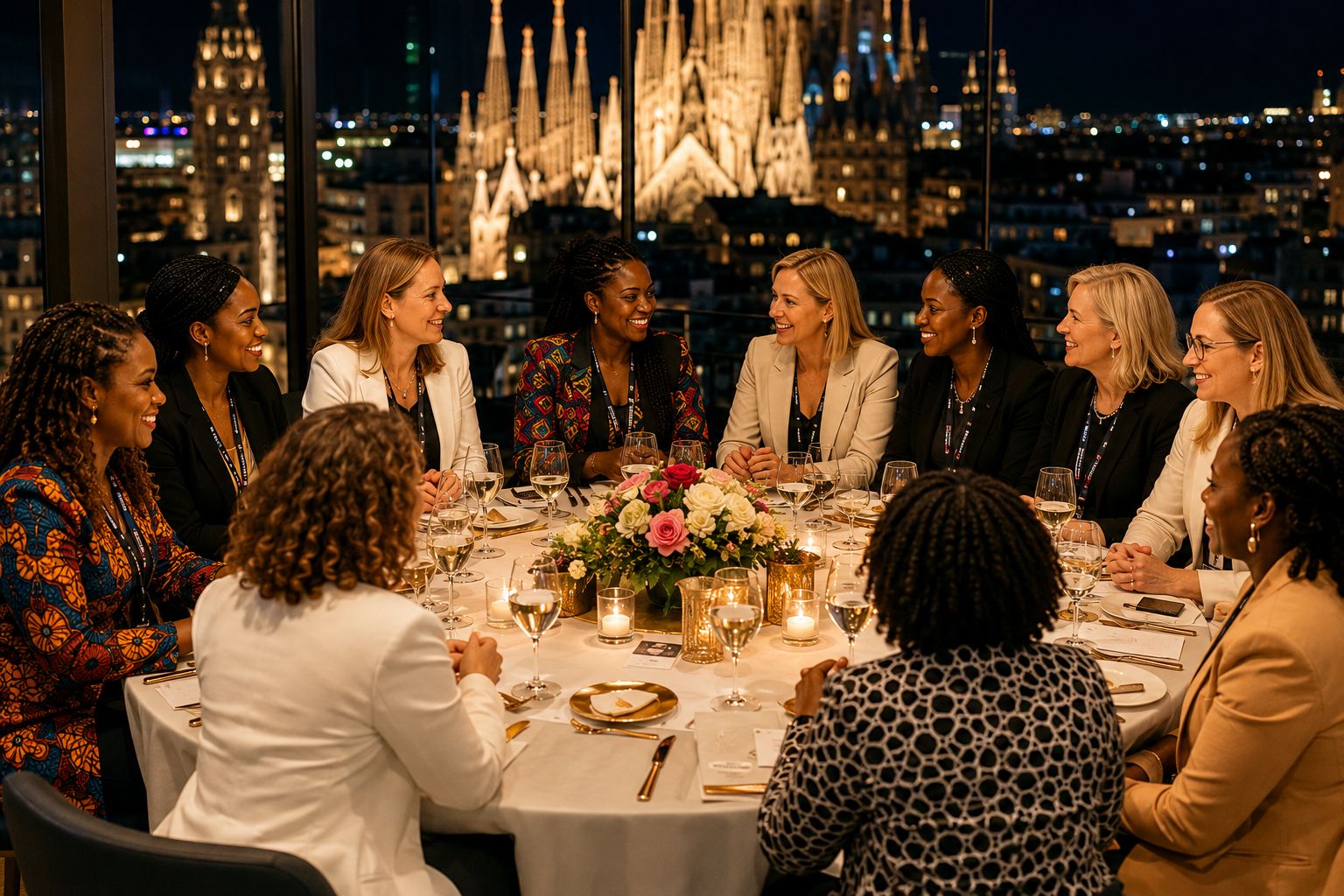
Return home with stronger confidence, new perspective and relationships that can compound over time.
WHY WLI EXISTS
Women Leading Innovation equips African women leaders with future-ready competencies in entrepreneurship, artificial intelligence, innovation management and global business transformation.
Through academic instruction, industry visits, guest lectures, innovation tours and cross-cultural exchange, delegates gain the knowledge, exposure and relationships to accelerate what they are already building.
Practical frameworks for building and scaling ventures in fast-moving markets.
Apply artificial intelligence tools to real operations, products and decisions.
Personal branding, executive presence and confident global leadership.
Direct exposure to companies, hubs and founders shaping Europe’s tech scene.
Cross-cultural exchange and relationship-building with global peers and mentors.
A lasting network of graduates mentoring the next cohort of women innovators.
Where it happens
Ten days split across Vic and Barcelona — combining focused academic immersion with direct access to one of Europe’s most dynamic innovation ecosystems.
DELEGATE PROFILE / 2027 COHORT
A cross-sector circle of African women who are building, leading and influencing what comes next.
From founders and executives to researchers, public servants and emerging innovators — the room is designed for meaningful exchange, not passive attendance.
Building and scaling ventures with purpose.
↗Creating solutions through digital innovation.
↗Translating knowledge into practical impact.
↗Turning bold ideas into viable businesses.
↗Leading transformation across organisations.
↗Strengthening systems, policy and delivery.
↗Advancing social impact and community change.
↗Bringing fresh perspectives and new possibilities.
↗Inside the experience
Academic depth, industry access and cultural immersion — built into a single itinerary.
Meet the team
A small team driving the programme from concept to delivery.

Program Director
Leading the programme vision, strategy and delivery for Women Leading Innovation 2027.
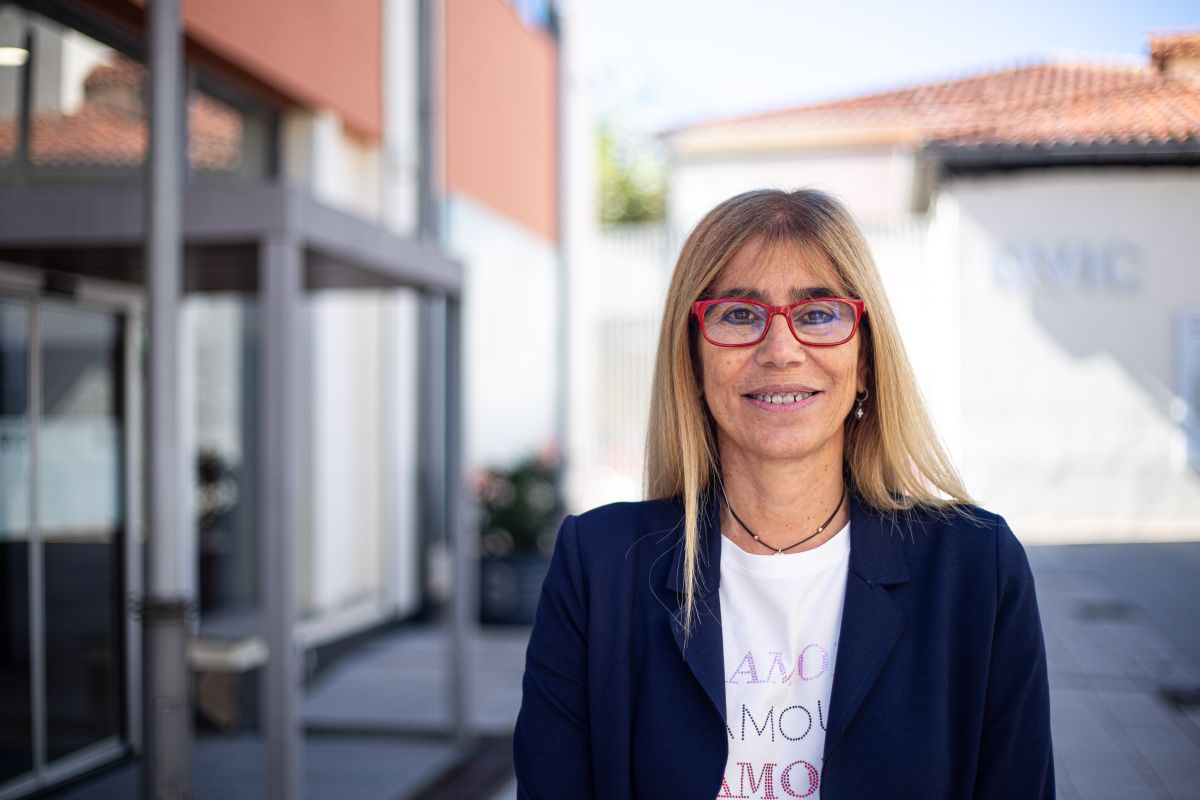
University of Vic, Spain Rep
Supporting the Spain-based academic and international exchange experience for WLI delegates.

Director, People, Culture & Operations, TVC

President, All African Association of Small and Medium Enterprises

Principal Ass. Registrar, Lead City University

Rep, Ghana
Supporting programme coordination and representation across the WLI Africa network.

PR x Comms
Driving communications, visibility and storytelling around the Women Leading Innovation experience.
Get involved
Women Leading Innovation 2027 is built by a community. Join us as a delegate, exhibitor, sponsor, strategic partner or country volunteer.
Join the cohort
Apply to be one of 30 African women leaders joining the ten-day study tour in Spain for learning, industry visits and cross-border networking.
Apply as a delegate →Showcase
Put your product, service or brand in front of a curated delegation of women founders, executives and innovators.
Express interest →Back the programme
Support the delivery of WLI 2027 and stand alongside a programme investing in African women’s leadership.
Express interest →Build with us
Collaborate with Tech4Her Africa as an institution, ecosystem builder or host to shape and extend the programme’s impact.
Start a conversation →Represent your country
Help recruit, support and coordinate delegates in your country as a trusted voice for WLI in the network.
Volunteer with us →Next steps
Complete the short form below and our team will be in touch.
Shortlisted applicants receive the full programme details and agreements.
Delegates complete selection; partners, exhibitors and volunteers confirm their role.
Take part in the ten-day experience, May 2027.
Register interest
Spaces are limited to thirty delegates. Tell us a little about yourself. Complete the form and we’ll be in touch.
Questions
The programme is open to African women entrepreneurs, SME owners, technologists, lecturers, researchers, startup founders, corporate executives, public sector professionals, NGO leaders and emerging innovators.
Yes, there is a programme fee that applies. Shortlisted delegates will be informed of the complete costs during the confirmation process.
You can join as an exhibitor, sponsor, strategic partner or country volunteer. Register your interest and tell us how you would like to be involved.
International flights, accommodation, meals, academic and faculty fees, industry visit costs, programme materials, travel insurance, visa support, cultural activities and on-ground coordination.
Yes. Delegates complete a short course with our host institution in Barcelona and receive a formal certificate of completion. Outstanding delegates are also recognised with programme awards at the closing ceremony.
Our team responds to all registrations within five working days with next steps and, where relevant, the full programme brief.
Yes. Many people and organisations contribute in more than one capacity. Tell us what you have in mind when we follow up after your registration.
<!DOCTYPE html>
<html lang=”en”>
<head>
<meta charset=”UTF-8″>
<meta name=”viewport” content=”width=device-width, initial-scale=1.0″>
<title>Farm-to-Plate AI Course</title>
<script src=”https://cdn.tailwindcss.com”></script>
<style>
.flip-card {
perspective: 1000px;
height: 200px;
}
.flip-card-inner {
position: relative;
width: 100%;
height: 100%;
transition: transform 0.6s;
transform-style: preserve-3d;
}
.flip-card.flipped .flip-card-inner {
transform: rotateY(180deg);
}
.flip-card-front, .flip-card-back {
position: absolute;
width: 100%;
height: 100%;
backface-visibility: hidden;
border-radius: 0.5rem;
display: flex;
align-items: center;
justify-content: center;
padding: 1.5rem;
text-align: center;
}
.flip-card-back {
transform: rotateY(180deg);
}
.code-block {
background: #1a1a1a;
color: #00ff00;
padding: 1rem;
border-radius: 0.5rem;
overflow-x: auto;
font-family: ‘Courier New’, monospace;
font-size: 0.875rem;
white-space: pre;
}
</style>
</head>
<body class=”bg-gradient-to-br from-green-50 to-blue-50 min-h-screen”>
<div id=”app”></div>
<script>
// Course Data
const courseData = {
1: {
title: “Week 1: Introduction & Context”,
sections: [
{
type: “intro”,
title: “Welcome”,
content: {
heading: “AI for African Smallholder Post-Harvest Management”,
stats: [
“30-50% of produce lost between harvest and market”,
“Billions in annual losses for smallholder farmers”,
“AI can reduce losses by 50%”
]
}
},
{
type: “lesson”,
title: “Post-Harvest Loss Problem”,
content: {
text: “Africa loses 30-50% of produce between harvest and market, costing smallholder farmers billions annually.”,
caseStudy: {
title: “Case Study: Maria’s Tomato Farm”,
current: “Loses 80kg (40%), earns 6,000 KES”,
withAI: “Loses 40kg (20%), earns 8,000 KES”
}
}
},
{
type: “flipcards”,
title: “Root Causes”,
cards: [
{ front: “Physical Losses”, back: “Bruising, rotting, pest damage during handling and transport” },
{ front: “Economic Losses”, back: “Price drops for damaged produce, rejection by buyers” },
{ front: “Infrastructure”, back: “No refrigeration, poor storage facilities” },
{ front: “Information Gap”, back: “Lack of real-time market data and quality tools” }
]
},
{
type: “quiz”,
title: “Week 1 Quiz”,
questions: [
{
q: “What percentage of produce is typically lost in Africa?”,
options: [“10-20%”, “30-50%”, “60-70%”, “80-90%”],
correct: 1
},
{
q: “Where are AI interventions most effective?”,
options: [“Harvest”, “Sorting & Storage”, “Transport”, “Market”],
correct: 1
}
]
}
]
},
2: {
title: “Week 2: Image Data Fundamentals”,
sections: [
{
type: “lesson”,
title: “Digital Images”,
content: {
text: “Understanding how cameras capture produce images.”,
concepts: [
{ term: “Pixels”, def: “Smallest unit of an image” },
{ term: “Resolution”, def: “Number of pixels (e.g., 1920×1080)” },
{ term: “Bit Depth”, def: “Number of bits per pixel (8-bit = 0-255)” }
]
}
},
{
type: “flipcards”,
title: “Color Spaces”,
cards: [
{ front: “RGB”, back: “Red-Green-Blue. Three channels 0-255. Common camera format.” },
{ front: “HSV”, back: “Hue-Saturation-Value. Better for colored defect detection.” },
{ front: “Grayscale”, back: “Single channel. Useful for texture analysis.” }
]
},
{
type: “code”,
title: “MATLAB Lab”,
code: “% Convert to HSV\nimg_rgb = imread(‘tomato.jpg’);\nimg_hsv = rgb2hsv(img_rgb);\n\n% Detect red regions\nH = img_hsv(:,:,1);\nred_mask = (H < 0.05 | H > 0.95);”
},
{
type: “quiz”,
title: “Week 2 Quiz”,
questions: [
{
q: “A 640×480 RGB image is stored as:”,
options: [“640×480 matrix”, “640×480×3 array”, “Three 640×480 matrices”, “Single array”],
correct: 1
}
]
}
]
},
3: {
title: “Week 3: Defect Detection”,
sections: [
{
type: “lesson”,
title: “Common Defects”,
content: {
defects: [
{ type: “Bruising”, impact: “20-40% price reduction” },
{ type: “Rot”, impact: “Rejection by buyers” },
{ type: “Sunburn”, impact: “Lower price tier” }
]
}
},
{
type: “flipcards”,
title: “Segmentation”,
cards: [
{ front: “Global Threshold”, back: “Single value for entire image. Simple but struggles with variable lighting.” },
{ front: “Adaptive Threshold”, back: “Local thresholds. Better for uneven lighting.” },
{ front: “Otsu’s Method”, back: “Automatic threshold selection. No manual tuning.” }
]
},
{
type: “code”,
title: “Detection Pipeline”,
code: “% Defect detection\nimg_gray = rgb2gray(img);\nthreshold = graythresh(img_gray);\nbw = imbinarize(img_gray, threshold);\n\n% Clean with morphology\nse = strel(‘disk’, 5);\nbw_clean = imopen(bw, se);”
},
{
type: “quiz”,
title: “Week 3 Quiz”,
questions: [
{
q: “Which operation removes small noise?”,
options: [“Dilation”, “Opening”, “Closing”, “Threshold”],
correct: 1
}
]
}
]
},
4: {
title: “Week 4: CNN Classification”,
sections: [
{
type: “lesson”,
title: “Grading System”,
content: {
grades: [
{ grade: “A”, desc: “No defects”, price: “100%” },
{ grade: “B”, desc: “Minor defects”, price: “60-80%” },
{ grade: “C”, desc: “Major defects”, price: “0-30%” }
]
}
},
{
type: “flipcards”,
title: “CNN Basics”,
cards: [
{ front: “What are CNNs?”, back: “Deep learning models that automatically learn features from images.” },
{ front: “Transfer Learning”, back: “Use pre-trained models and fine-tune for your task.” },
{ front: “Why CNNs?”, back: “Handle variations, scale well, work with limited data.” }
]
},
{
type: “code”,
title: “CNN Training”,
code: “% Load MobileNet\nnet = mobilenetv2;\n\n% Replace final layer\nlgraph = layerGraph(net);\nnewFC = fullyConnectedLayer(3);\nlgraph = replaceLayer(lgraph, ‘Logits’, newFC);\n\n% Train\nnet_trained = trainNetwork(imds, lgraph, options);”
},
{
type: “quiz”,
title: “Week 4 Quiz”,
questions: [
{
q: “Main advantage of transfer learning?”,
options: [“Faster training”, “Works with limited data”, “Smaller model”, “Better always”],
correct: 1
}
]
}
]
}
};
// State Management
let state = {
currentWeek: 1,
currentSection: 0,
completed: {},
quizAnswers: {},
flipped: {}
};
// Load saved progress
function loadProgress() {
const saved = localStorage.getItem(‘farmToPlateProgress’);
if (saved) {
state = { …state, …JSON.parse(saved) };
}
}
// Save progress
function saveProgress() {
localStorage.setItem(‘farmToPlateProgress’, JSON.stringify(state));
}
// Navigation
function navigate(week, section) {
state.currentWeek = week;
state.currentSection = section;
saveProgress();
render();
}
function nextSection() {
const week = courseData[state.currentWeek];
if (state.currentSection < week.sections.length – 1) {
navigate(state.currentWeek, state.currentSection + 1);
} else if (state.currentWeek < 4) {
navigate(state.currentWeek + 1, 0);
}
}
function prevSection() {
if (state.currentSection > 0) {
navigate(state.currentWeek, state.currentSection – 1);
} else if (state.currentWeek > 1) {
const prevWeek = state.currentWeek – 1;
navigate(prevWeek, courseData[prevWeek].sections.length – 1);
}
}
function markComplete() {
state.completed[`${state.currentWeek}-${state.currentSection}`] = true;
saveProgress();
render();
}
// Render functions
function renderSection(section, idx) {
const key = `${state.currentWeek}-${idx}`;
switch(section.type) {
case ‘intro’:
return `
<div class=”space-y-6″>
<div class=”bg-gradient-to-r from-green-600 to-blue-600 text-white p-8 rounded-lg”>
<h2 class=”text-3xl font-bold mb-4″>${section.content.heading}</h2>
</div>
<div class=”grid md:grid-cols-3 gap-4″>
${section.content.stats.map(stat => `
<div class=”bg-white p-6 rounded-lg shadow-md border-l-4 border-green-500″>
<p class=”text-gray-700″>${stat}</p>
</div>
`).join(”)}
</div>
<button onclick=”markComplete()” class=”w-full bg-green-600 text-white py-3 rounded-lg font-semibold hover:bg-green-700″>
Continue
</button>
</div>
`;
case ‘lesson’:
return `
<div class=”space-y-6″>
<div class=”bg-white p-6 rounded-lg shadow-md”>
<p class=”text-lg text-gray-700 mb-4″>${section.content.text}</p>
${section.content.caseStudy ? `
<div class=”bg-blue-50 p-6 rounded-lg mt-6″>
<h4 class=”font-bold text-blue-900 mb-3″>${section.content.caseStudy.title}</h4>
<div class=”grid md:grid-cols-2 gap-4″>
<div class=”bg-red-50 p-4 rounded”>
<p class=”font-semibold text-red-900 mb-2″>Current</p>
<p class=”text-sm”>${section.content.caseStudy.current}</p>
</div>
<div class=”bg-green-50 p-4 rounded”>
<p class=”font-semibold text-green-900 mb-2″>With AI</p>
<p class=”text-sm”>${section.content.caseStudy.withAI}</p>
</div>
</div>
</div>
` : ”}
${section.content.concepts ? `
<div class=”space-y-3 mt-6″>
${section.content.concepts.map(c => `
<div class=”border-l-4 border-blue-500 pl-4 py-2″>
<p class=”font-semibold”>${c.term}</p>
<p class=”text-sm text-gray-600″>${c.def}</p>
</div>
`).join(”)}
</div>
` : ”}
${section.content.defects ? `
<div class=”space-y-3 mt-6″>
${section.content.defects.map(d => `
<div class=”bg-gray-50 p-4 rounded-lg”>
<p class=”font-bold”>${d.type}</p>
<p class=”text-sm text-red-600″>${d.impact}</p>
</div>
`).join(”)}
</div>
` : ”}
${section.content.grades ? `
<div class=”space-y-3 mt-6″>
${section.content.grades.map(g => `
<div class=”bg-gray-50 p-4 rounded-lg border-2 border-gray-200″>
<p class=”font-bold”>Grade ${g.grade}</p>
<p class=”text-sm text-gray-600″>${g.desc}</p>
<p class=”text-sm text-green-600 font-semibold”>${g.price}</p>
</div>
`).join(”)}
</div>
` : ”}
</div>
<button onclick=”markComplete()” class=”w-full bg-green-600 text-white py-3 rounded-lg font-semibold hover:bg-green-700″>
Continue
</button>
</div>
`;
case ‘flipcards’:
return `
<div class=”space-y-6″>
<div class=”bg-blue-50 p-4 rounded-lg”>
<p class=”text-center text-blue-900″>Click each card to flip</p>
</div>
<div class=”grid md:grid-cols-2 gap-6″>
${section.cards.map((card, i) => `
<div class=”flip-card ${state.flipped[`${key}-${i}`] ? ‘flipped’ : ”}”
onclick=”flipCard(‘${key}-${i}’)”>
<div class=”flip-card-inner”>
<div class=”flip-card-front bg-gradient-to-br from-green-500 to-green-600 text-white”>
<div>
<p class=”text-xl font-bold”>${card.front}</p>
<p class=”text-sm mt-2 opacity-75″>Click to flip</p>
</div>
</div>
<div class=”flip-card-back bg-gradient-to-br from-blue-500 to-blue-600 text-white”>
<p class=”text-sm”>${card.back}</p>
</div>
</div>
</div>
`).join(”)}
</div>
<button onclick=”markComplete()” class=”w-full bg-green-600 text-white py-3 rounded-lg font-semibold hover:bg-green-700″>
Continue
</button>
</div>
`;
case ‘code’:
return `
<div class=”space-y-6″>
<div class=”bg-white p-6 rounded-lg shadow-md”>
<h4 class=”font-bold text-lg mb-4″>💻 MATLAB Code Example</h4>
<div class=”code-block”>${section.code}</div>
</div>
<button onclick=”markComplete()” class=”w-full bg-green-600 text-white py-3 rounded-lg font-semibold hover:bg-green-700″>
Mark Complete
</button>
</div>
`;
case ‘quiz’:
return renderQuiz(section.questions, key);
}
}
function renderQuiz(questions, key) {
const answers = state.quizAnswers[key] || {};
const submitted = state.completed[key];
let html = ‘<div class=”space-y-6″>’;
questions.forEach((q, qIdx) => {
html += `
<div class=”bg-white p-6 rounded-lg shadow-md”>
<p class=”font-semibold mb-4″>${qIdx + 1}. ${q.q}</p>
<div class=”space-y-2″>
${q.options.map((opt, oIdx) => {
const selected = answers[qIdx] === oIdx;
const correct = oIdx === q.correct;
const showFeedback = submitted && selected;
return `
<button onclick=”answerQuiz(‘${key}’, ${qIdx}, ${oIdx})”
${submitted ? ‘disabled’ : ”}
class=”w-full text-left p-3 rounded-lg border-2 transition-all ${
showFeedback
? (correct ? ‘border-green-500 bg-green-50’ : ‘border-red-500 bg-red-50’)
: (selected ? ‘border-blue-500 bg-blue-50’ : ‘border-gray-200 hover:border-gray-300’)
}”>
${opt}
${showFeedback ? (correct ? ‘ ✓’ : ‘ ✗’) : ”}
</button>
`;
}).join(”)}
</div>
</div>
`;
});
if (!submitted) {
const allAnswered = Object.keys(answers).length === questions.length;
html += `
<button onclick=”submitQuiz(‘${key}’, ${questions.length})”
${!allAnswered ? ‘disabled’ : ”}
class=”w-full bg-green-600 text-white py-3 rounded-lg font-semibold hover:bg-green-700 disabled:bg-gray-300″>
Submit Quiz
</button>
`;
} else {
const score = questions.reduce((acc, q, i) => acc + (answers[i] === q.correct ? 1 : 0), 0);
html += `
<div class=”bg-blue-50 p-6 rounded-lg text-center”>
<p class=”text-2xl font-bold text-blue-900″>Score: ${score}/${questions.length}</p>
<p class=”text-gray-600 mt-2″>${score === questions.length ? ‘Perfect! 🎉’ : ‘Great job! 👏’}</p>
</div>
`;
}
html += ‘</div>’;
return html;
}
function flipCard(cardId) {
state.flipped[cardId] = !state.flipped[cardId];
render();
}
function answerQuiz(key, qIdx, answer) {
if (!state.quizAnswers[key]) state.quizAnswers[key] = {};
state.quizAnswers[key][qIdx] = answer;
saveProgress();
render();
}
function submitQuiz(key, numQuestions) {
markComplete();
}
function render() {
const week = courseData[state.currentWeek];
const section = week.sections[state.currentSection];
const progress = (Object.keys(state.completed).length / 16) * 100;
document.getElementById(‘app’).innerHTML = `
<div class=”max-w-6xl mx-auto px-4 py-6″>
<!– Header –>
<div class=”bg-white shadow-md rounded-lg p-4 mb-6″>
<div class=”flex items-center justify-between mb-2″>
<h1 class=”text-2xl font-bold text-gray-900″>Farm-to-Plate AI</h1>
<span class=”text-sm font-semibold text-gray-600″>Week ${state.currentWeek} of 4</span>
</div>
<div class=”mt-3″>
<div class=”flex items-center justify-between text-sm text-gray-600 mb-1″>
<span>Progress</span>
<span>${Math.round(progress)}%</span>
</div>
<div class=”w-full bg-gray-200 rounded-full h-3″>
<div class=”bg-gradient-to-r from-green-500 to-blue-500 h-3 rounded-full transition-all”
style=”width: ${progress}%”></div>
</div>
</div>
</div>
<!– Week Tabs –>
<div class=”grid grid-cols-4 gap-4 mb-6″>
${[1,2,3,4].map(w => `
<button onclick=”navigate(${w}, 0)”
class=”p-4 rounded-lg font-semibold ${state.currentWeek === w ? ‘bg-green-600 text-white’ : ‘bg-white text-gray-600 hover:bg-gray-50’}”>
Week ${w}
</button>
`).join(”)}
</div>
<!– Content –>
<div class=”bg-white rounded-lg shadow-xl p-8 mb-6″>
<div class=”mb-6″>
<h2 class=”text-2xl font-bold text-gray-900 mb-2″>${week.title}</h2>
<p class=”text-gray-600″>Section ${state.currentSection + 1} of ${week.sections.length}: ${section.title}</p>
</div>
${renderSection(section, state.currentSection)}
</div>
<!– Navigation –>
<div class=”flex justify-between”>
<button onclick=”prevSection()”
${state.currentWeek === 1 && state.currentSection === 0 ? ‘disabled’ : ”}
class=”px-6 py-3 bg-gray-600 text-white rounded-lg font-semibold hover:bg-gray-700 disabled:bg-gray-300″>
← Previous
</button>
<button onclick=”nextSection()”
${state.currentWeek === 4 && state.currentSection === week.sections.length – 1 ? ‘disabled’ : ”}
class=”px-6 py-3 bg-green-600 text-white rounded-lg font-semibold hover:bg-green-700 disabled:bg-gray-300″>
Next →
</button>
</div>
</div>
`;
}
// Initialize
loadProgress();
render();
</script>
</body>
</html>
Farm-to-Plate AI: Enhance Freshness & Reduce Waste with Robotics and Computer Vision
Nigeria loses nearly half of its fresh produce before it reaches consumers—a challenge that demands smart, tech-driven solutions. DataDiva Bootcamp 2.0 empowers women to harness the power of AI, robotics, and computer vision to build innovative solutions that detect food quality, extend shelf life, and reduce waste from farm to plate.
This hands-on bootcamp combines practical training, expert mentorship, and real-world problem solving to equip participants with the tools to create impact in agriculture and food systems.
📍 Location: University of Lagos (Hybrid)
📅 Date: December 2025 (to be confirmed)
🕒 Time: To be announced
🎟️ Registration: Free
Tech4Her Africa – DataDiva Initiative in partnership with WiDS (Women in Data Science Worldwide)
Empowering women through data, AI, and digital innovation to create sustainable impact across Africa.
Reducing Farm Post-Harvest Waste via Robotics & Computer Vision
This project aims to design, prototype, and deploy an intelligent system combining robotics and computer vision to monitor, sort, and manage fresh produce along the supply chain—from harvest to retail. The goal is to maximize freshness, minimize spoilage, and optimize logistic decisions (e.g. routing, storage) using AI models and automated hardware.

AI is transforming the world, and it’s easier than ever for women to step in and innovate. If you’ve ever thought coding was too tough or AI was out of reach, this program is for you!
💡 Tech4Her Africa presents a 5-day upskilling journey where you’ll learn to harness AI tools, build intelligent applications, and gain confidence in your tech abilities—no advanced coding required!
💡 AI is no longer the future—it’s the NOW. Let’s build, create, and lead together.
#WomenInAI #Tech4Her #AIUpskill #FutureTech #NoCodeAI
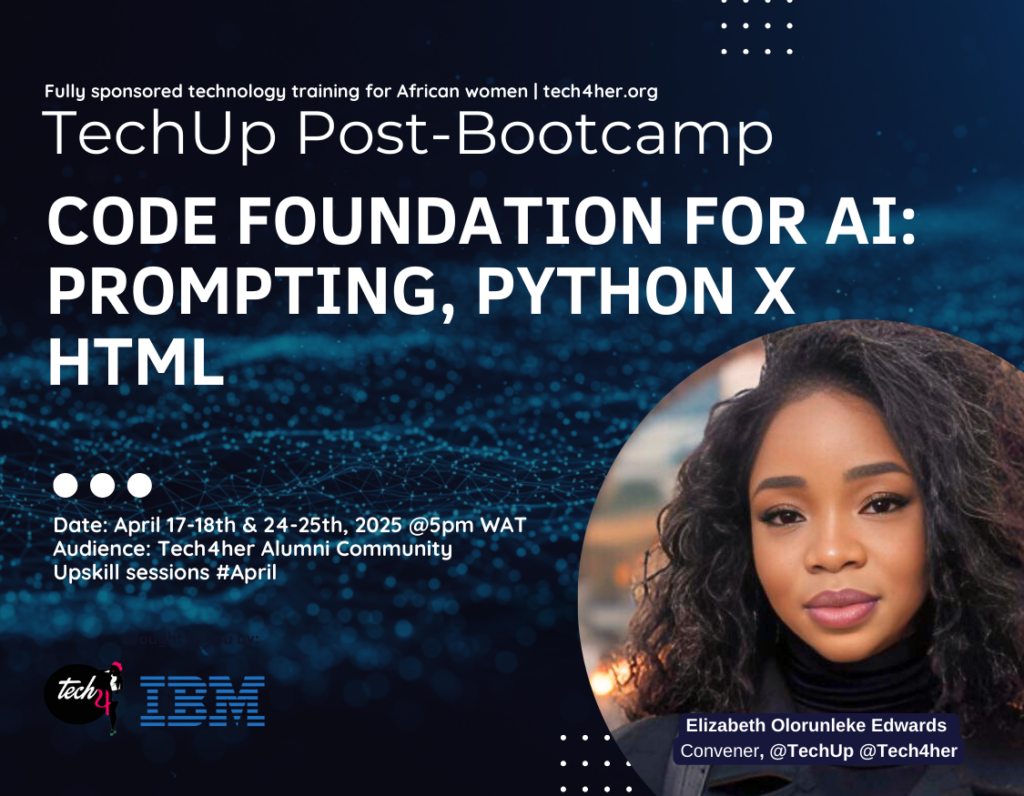
💡 Remember when coding felt like a barrier? Long lines of code, endless debugging, and the fear of “hard coding” kept many from stepping into tech. But guess what? The game has changed!
With AI, you no longer need to be a full-time programmer to build apps, create solutions, and innovate. Now, you can prompt AI to do the heavy lifting—but to truly master it, you need just a little foundation in Prompting, Python, and HTML.
🚀 This is not just a tech session—it’s a movement. A movement to show women that tech is no longer an exclusive club of coders, but a space where creativity, strategy, and the right knowledge can take you further than you ever imagined.
🌟 Elizabeth Olorunleke Edwards – A visionary leader driving tech inclusivity, empowering women through TechUp @Tech4Her.
💡 If you’ve ever dreamed of creating without coding fear—this is your moment. Join us for this fully sponsored training, powered by Tech4Her & IBM!
📢 Tag a friend who needs this & spread the word! 🚀
#Tech4Her #AI #Python #HTML #WomenInTech #AIforEveryone
Welcome to WordPress. This is your first post. Edit or delete it, then start writing!
User interface design is an integral part of any product development process. It involves creating an interface that users can interact with seamlessly, efficiently, and enjoyably. Two essential principles in UI design are consistency and signifiers.
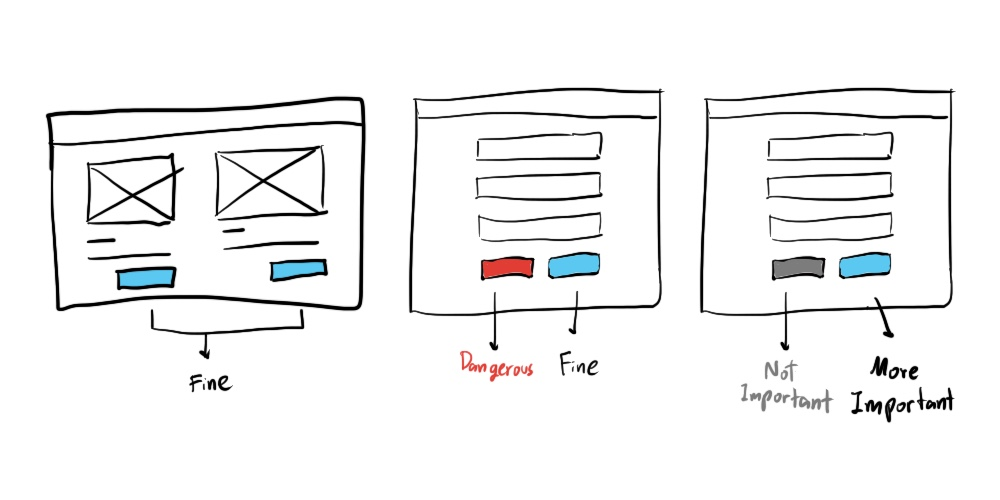
Consistency refers to the uniformity of the interface design across different pages, screens, and interactions. It makes it easy for users to navigate and understand the product. When a product has a consistent design, users can quickly learn how to perform different actions and predict what will happen when they click on different buttons.
On the other hand, signifiers refer to the visual cues that help users understand how to interact with the product. They include buttons, icons, color, and typography. Signifiers should be clear and easy to understand to avoid confusion and frustration for users.
Consistency and signifiers are crucial in UI design because they improve the user experience, reduce errors, and increase user engagement. When a product is consistent, users are more likely to trust it and feel confident using it. Signifiers help users understand the product’s functionality and how to navigate it, reducing the learning curve.
In conclusion, consistency and signifiers are essential principles in UI design. They create a seamless user experience and help users navigate and understand the product. As a UI designer, it’s essential to keep these principles in mind when designing interfaces to ensure the best possible user experience.
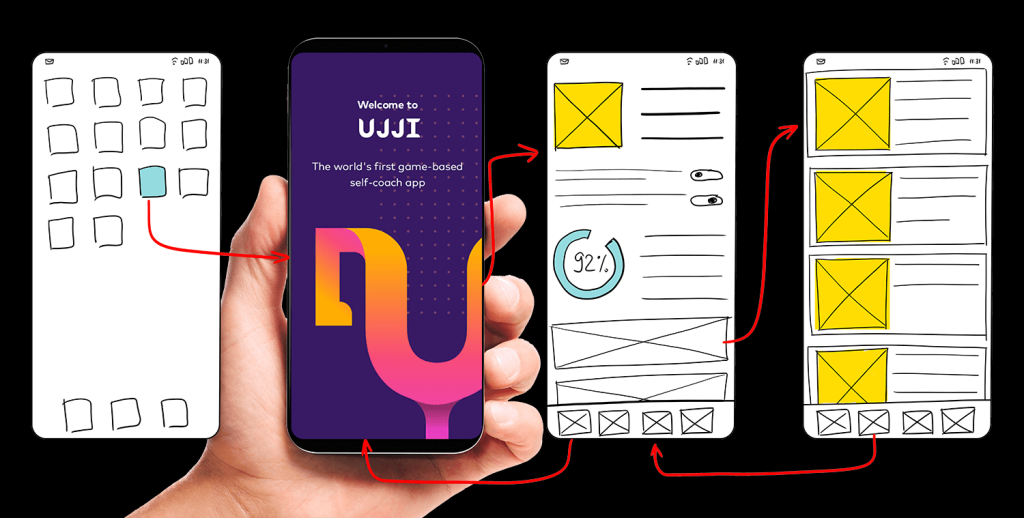
The user interface (UI) acts as the medium of interaction between a user and a device or technology. It comprises of a set of visual components and controls such as menus, buttons, and icons that enable users to control and interact with the system. UI can either be graphical, as seen on a smartphone or computer, or command-line based as found on a computer’s command-line interface.
An effective user interface should possess attributes such as ease of use, visual appeal, and should provide users with clear and consistent feedback. It should also be designed in such a way that it is intuitive and efficient, making it easy for users to perform the necessary tasks with ease.
In designing a user interface, the layout, visual elements, interactions, and feedback are taken into consideration to create a satisfying and user-friendly experience with the product. The process is iterative, requiring continuous testing and improvement, as designers work in tandem with developers and stakeholders.
UX (User Experience) and UI (User Interface) are two closely related yet distinct fields in design. UX design focuses on the overall feel and flow of a product, from research and prototyping to testing and iteration. It aims to understand the user needs, motivations, and behaviors and create a product that meets their goals efficiently and effectively. UX design includes aspects such as information architecture, wireframing, and usability testing.
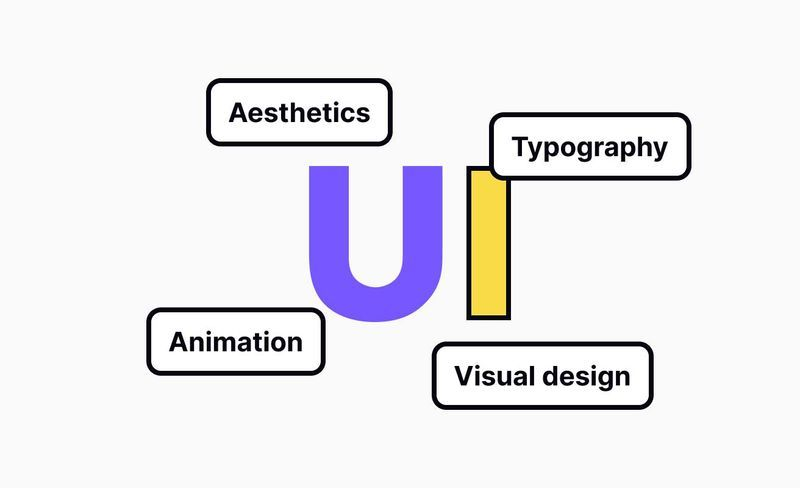
UI design, on the other hand, focuses on the look and feel of a product. It involves designing visual elements such as colors, typography, and iconography, as well as the layout and structure of a product’s interface.
A UI (User Interface) designer is a professional responsible for the design of the graphical interface of a product, such as a website or application. They are responsible for creating the look and feel of the product, including the layout, typography, color palette, and visual elements such as buttons and icons.
A UI designer works closely with UX designers and developers to ensure that the interface is aesthetically pleasing, user-friendly, and consistent with the overall design style of the product. They may also be involved in creating and testing prototypes, as well as updating and maintaining the visual design as the product evolves.
The role of a UI designer requires a strong understanding of visual design principles, as well as the ability to create wireframes, mockups, and prototypes using design software. Good communication and collaboration skills are also important, as the UI designer must work closely with other members of the design and development teams.
Attention UI designers! When creating digital products, it’s important to keep in mind two crucial design principles: affordance and feedback.
Affordance refers to the perceived functionality of an object based on its design. For example, a button with a raised appearance and a shadow effect is perceived as something that can be clicked. On the other hand, a flat image without any raised appearance may not be perceived as clickable, and therefore not an effective affordance.
Feedback is the process of giving users clear and immediate responses to their actions within a digital product. This can come in the form of an animation, sound, or visual cue. Providing feedback lets users know that their actions have been registered and encourages continued engagement.
When designing a user interface, it’s important to keep both of these principles in mind to create a seamless user experience. #UIDesign #UserExperience #DesignPrinciples